Introduction

Canada's largest & most innovative
Online Arbitration & Legal Opinion Network
Ideal for Individuals & Companies
With offline networking
Canada
Canada's largest & most innovative
Online Arbitration & Legal Opinion Network
Ideal for Individuals & Companies
With offline networking

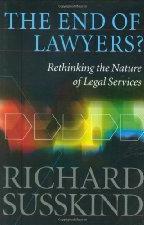
Rethinking the Nature of Legal Services by Richard Susskind OBE and Are Lawyers doomed ?
A few quotes from readers :
"Challenging book about how legal services will be produced and delivered in the future."
"Brilliant ideas, new ways for legal professionals (my clients) to do and sell their work. Gives a good overview what technology has to offer in the future, also affecting the legal translators market.""Makes a good case that lawyers must either innovate or face increasing risk of becoming obsolete."
"For me, this is a reference book. It helps me deliver high value to my clients."
"Richard sets a new challenge for all lawyers. He urges them to ask themselves what elements of their current workload could be undertaken more quickly, more cheaply, more efficiently, or to a higher quality using different and new methods of working. He argues that the market is unlikely to tolerate expensive lawyers for tasks that can be better discharged with support of modern systems and techniques. He claims that the legal profession will be driven by two forces in the coming decade: by a market pull towards the commoditisation of legal services, and by the pervasive development and uptake of new and disruptive legal technologies. The threat here for lawyers is clear - their jobs may well be eroded or even displaced. At the same time, for entrepreneurial lawyers, Susskind foresees quite different law jobs emerging which may be highly rewarding, even if very different from those of today". Read more »
The End of Lawyers? by Richard Susskind (London: Oxford University Press, 2008)
Canada experiences, in common with most western democracies, an increasingly complicated society. It is, therefore, no surprise that the legal system across the country gets clogged up, especially where it regards civil and common law areas. The waiting time for trial can be anywhere from six months to three years or longer. Suggested reading: The Litigation Process
Even Small Claims Courts in Canada which provide a resolution for simple cases will take you the better part of a year to go through the entire Small Claims Court process i.e. have your trial and get judgement. Collecting adds further delay and is an entirely different story, it is by no means the easiest undertaking both in terms of additional expense and duration.Apart from the unacceptable time it takes to find judgement in regular government courts, the actual litigation process also adds a mystique for many people and makes the entire process through the traditional courts a very frustrating and intimidating experience to the layperson.Click for video - The need for e-Court.
In recognition to above, e-Court has been introduced to provide competent, affordable, simple, speedy and transparent justice for everyone. e-Court also provides a uniform litigation system throughout Canada without the need to understand the peculiarities existing in each provincial legislative system. We encourage you to read about e-Court in the following pages. You shall not be disappointed. Join e-Court with the knowledge that legal justice is rendered with prior knowledge of expense and duration. It is expected that e-Court during its first six months of operations is capable of handling a minimum of #2,000 cases at any one time, with at least #20,000 cases at full maturity.